
Junior Chess Tournaments in Victoria: A Parent's Guide
How junior chess tournaments work in Melbourne and Victoria: Swiss formats, rapid vs classical, ratings, touch-move and etiquette, plus a first-tournament checklist.
4 min read
Quick answer: Most junior chess tournaments in Victoria use a Swiss format. Every child plays every round against opponents on a similar score, so nobody is knocked out. Beginners should start with a friendly rapid event (about 15–30 minutes per player), learn touch-move and clock etiquette beforehand, and focus on enjoying the day rather than the result.
Your child's first chess tournament is a big moment, for them and for you. Having played and coached in many events, I've seen how much smoother the day goes when families know what to expect. This guide covers how tournaments work in Victoria, the rules that catch beginners out, and how to prepare.
How a junior chess tournament works
The Swiss system: nobody gets knocked out
Most junior events use a Swiss system:
- Everyone plays every round, usually 5–7 rounds in a day.
- After round one, you're paired with players on a similar score.
- You never play the same opponent twice.
- Scoring is simple: 1 point for a win, ½ for a draw, 0 for a loss.
That's why Swiss events are great for children. Even after a loss in round one, they'll quickly be paired with players at their level.
Age groups and sections
Junior events are usually split by age group, often based on birth year (for example, Under 8, Under 10, Under 12), and sometimes into separate girls' sections or rating-based sections.
Rapid, blitz or classical: what's the difference?
Under FIDE's Laws of Chess, events are classified by how much time each player has:
| Format | Time per player (approx.) | Good for |
|---|---|---|
| Blitz | 10 minutes or less | Fun side events; not ideal for a first tournament |
| Rapid | More than 10 and less than 60 minutes | Best for first tournaments. Most junior events use rapid |
| Classical / standard | 60 minutes or more | Experienced juniors; usually requires writing down every move |
Time controls often include an increment, extra seconds added after every move (for example "15 + 5"). This means children can't lose purely because the clock runs out at the end.
Ratings explained: ACF and FIDE
Once children play rated events, they'll get a rating:
- ACF ratings are run by the Australian Chess Federation, the national body, for rated events in Australia. There are separate ratings for classical and faster games.
- FIDE ratings are international ratings for FIDE-rated events.
Ratings rise when a player scores better than expected against their opponents and fall when they score worse. Ratings are a long-term measure. One bad day doesn't matter, and children shouldn't be judged by their rating.
The rules that catch beginners out
Touch-move
If your child deliberately touches one of their pieces, they must move it (if it has a legal move). If they touch an opponent's piece, they must capture it if they can. To straighten a piece, they say "I adjust" first.
Using the clock
- Press the clock with the same hand that moved the piece.
- Don't hover over the clock or slam it.
- If your opponent forgets to press their clock, it's fine to let it run. You don't have to tell them.
Illegal moves and calling the arbiter
The arbiter is the referee. If something goes wrong, such as an illegal move or a disagreement, the right thing to do is stop the clock and raise a hand. Children should never argue with an opponent. Practising this calmly at home helps.
Etiquette
- Shake hands before and after the game.
- No talking during games, and no help from parents or friends.
- Stay quiet near other boards after finishing.
- Losing gracefully matters. Say "good game" and move on.
First tournament checklist
Before the day
- Play several full games with a clock at home or in class
- Practise touch-move and pressing the clock
- Know how to checkmate with a queen and with a rook
- Register early, because junior events often fill up
What to pack
- Water bottle and healthy snacks
- A pen (for classical events or scoresheets)
- A quiet activity for between rounds (book, drawing, puzzles)
- A jumper, as halls can be cold
On the day
- Arrive 20–30 minutes early to check in
- Find the pairings board before each round
- Between rounds: rest, eat, and don't dwell on the last game
How parents can help on the day
- Ask about the effort, not the score. "Which game did you enjoy most?" is a great question.
- Stay calm and neutral. Children pick up on your nerves.
- Celebrate small wins: finishing every round, a good fight, or recovering after a loss.
- Review later, not immediately. Save game analysis for the next class with their coach.
Tournaments in Melbourne and beyond
Victoria has a busy junior chess calendar, from friendly weekend rapid events and school competitions to state junior championships. The national highlight is the Australian Junior Chess Championships, usually held in January. Chess Victoria, the state association, and the Australian Chess Federation publish event information.
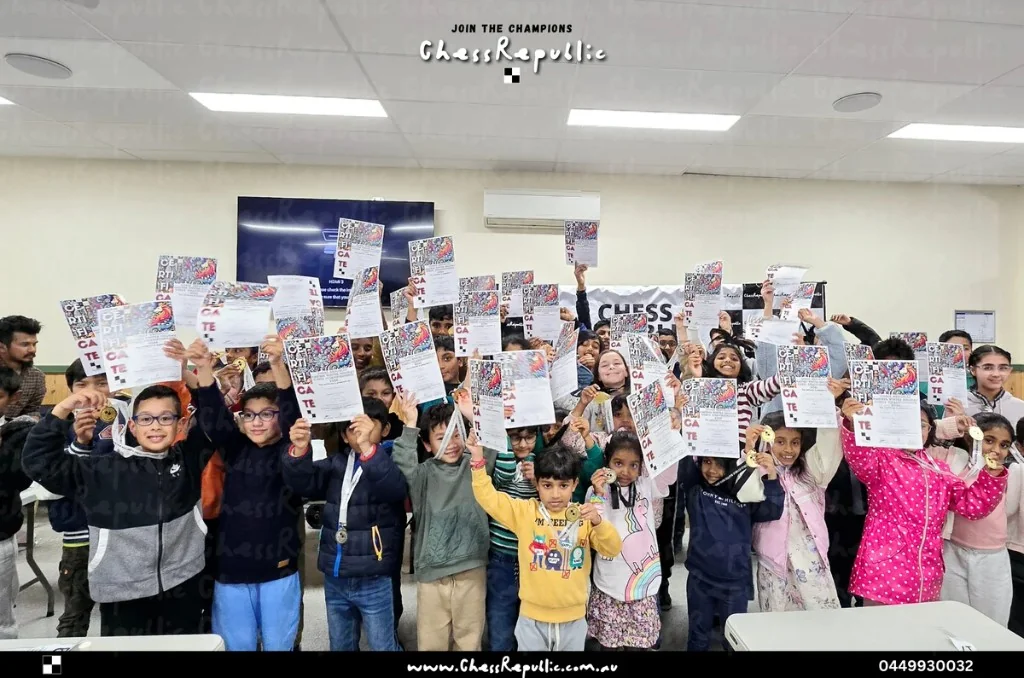
Chess Republic also runs friendly junior tournaments with age-group sections, medals and certificates, and our coaches prepare students for local, state and national events as part of weekly classes.
New to chess? Start with Chess for Kids: The Complete Guide for Australian Parents.
Key takeaways
- In a Swiss tournament nobody is knocked out. Children play every round against opponents on similar scores.
- Rapid events (more than 10 and under 60 minutes per player) are the best place to start. Classical events are longer and usually require writing down moves.
- Learn touch-move, clock etiquette and how to call an arbiter before the first event.
- Ratings from the Australian Chess Federation (ACF) and FIDE track progress over time. Rated events come after a few friendly ones.
- Pack water, snacks, a pen and something quiet to do between rounds.
Frequently asked questions
When is my child ready for their first chess tournament?
When they can play a complete game with correct rules, know how to checkmate, and are comfortable playing without help for 20–30 minutes. For most children in weekly classes, that's within two or three terms. Start with a friendly, unrated junior event.
How do chess ratings work for juniors in Australia?
Games in rated Australian events count towards Australian Chess Federation (ACF) ratings, and FIDE-rated events count towards an international FIDE rating. Ratings go up when you score better than expected against your opponents, and down when you score worse. They're a long-term measure of progress, not a judgement on any single day.
What does touch-move mean in chess?
If a player deliberately touches one of their own pieces, they must move it if it has a legal move. If they touch an opponent's piece, they must capture it if possible. To straighten a piece without moving it, say 'I adjust' (or 'j'adoube') first.
Can parents watch junior chess tournaments?
Usually parents can watch from a distance or from a spectator area, but they must not talk to or signal players during games. Many events keep parents outside the playing hall to keep things quiet and fair. Check the organiser's rules on the day.